

Course Introduction
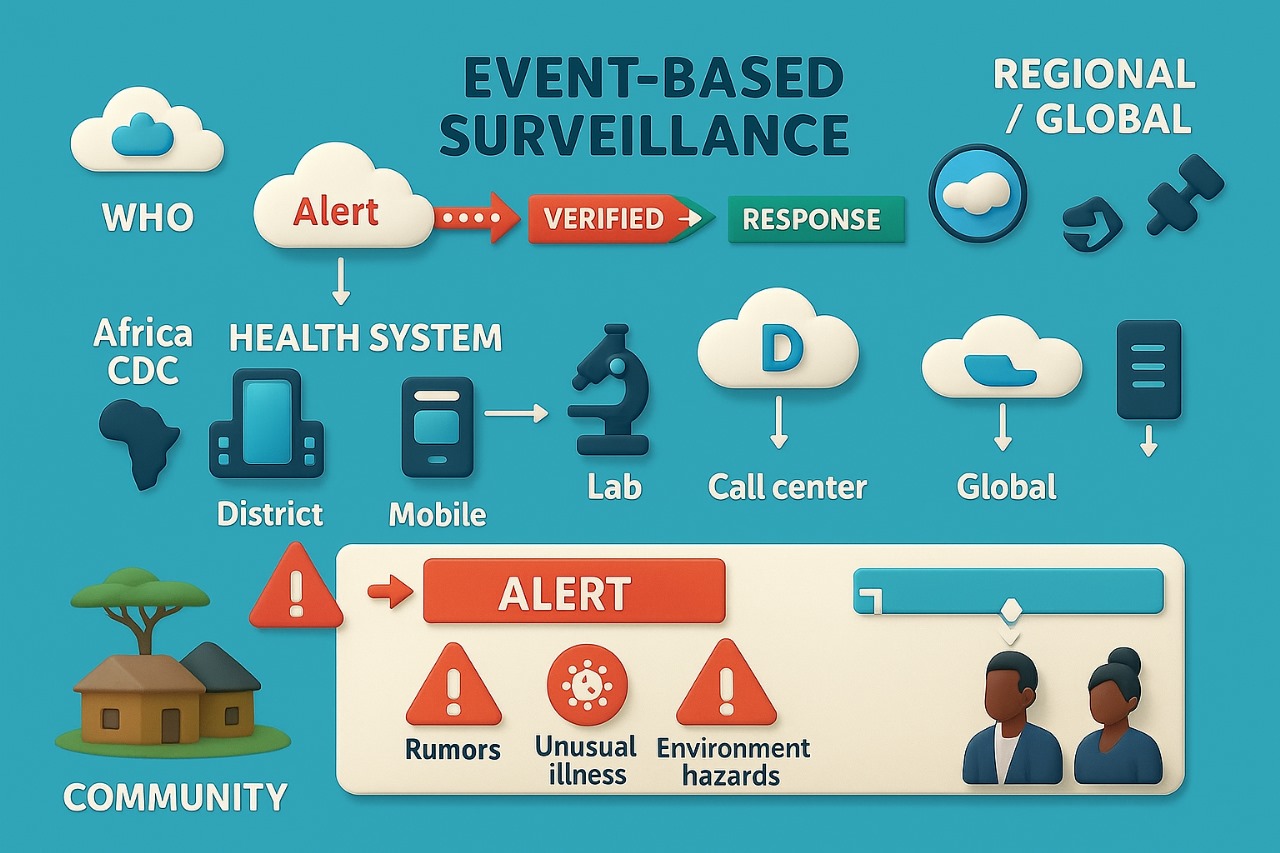
In today’s interconnected world, health threats emerge rapidly, from infectious disease outbreaks to environmental hazards and community-level rumors. Event-Based Surveillance (EBS) enables health systems to detect, verify, and respond to unusual events in real time, safeguarding populations and preventing crises. This course equips you with the knowledge and practical skills to contribute to EBS implementation at community, national, and global levels.
Some of the topics you will cover include;
- Public Health Surveillance
- Strategies for implementation of Event-based surveillance in Kenya
- Signal detection, reporting, triaging, verification, risk assessment, public health response and escalation
- EBS Training approach
- Mentorship and adult learning principles
- Monitoring, evaluation, and supportive supervision in EBS
- Digital applications supporting EBS
When can you start?
Start straight away and join hundreds of enthusiastic EBS actors taking this course.
How long will it take you to finish this course?
This is a self-paced course, allowing you the flexibility to log in and finish the learning at your convenience. To successfully complete the material, we advise setting aside approximately 3–4 hours for each of the five units in this course.
What will you achieve?
By the end of the course, you will be able to:
- Describe the background of Event-Based Surveillance
- Describe the process of Event-Based Surveillance
- Conduct training and mentorship for Event-Based Surveillance actors
- Implement monitoring and evaluation strategies in Event-Based Surveillance
- Utilize digital applications in Event-Based Surveillance
- Contribute to public health preparedness and response at local, national, and global levels
Who is the course for?
This course is designed for:
- EBS actors drawn from human, animal and environmental health
- Surveillance officers from all health care levels
- Humanitarian and emergencies responders
- Public health professionals, healthcare workers and policymakers
- Students and researchers interested in EBS
EBS skills are highly valued in outbreak preparedness, humanitarian response, and health system strengthening, making this course relevant for both new learners and experienced practitioners.
How can you achieve certification?
Please note the following requirements for successful completion:
- All learning units and resources are freely accessible and may be completed in any order.
- Each unit has its own assessment at the end.
- To unlock and attempt a unit assessment, you must have accessed at least 80% of the learning activities within that unit.
- To successfully complete a unit, you must score at least 80% in the respective unit’s assessment.
To be awarded a course completion certificate, you must:
· Complete all five (5) unit assessments, and
· Achieve a minimum score of 80% in each unit assessment.
Learners who do not achieve the required score may review the learning content and reattempt the assessment for up to three attempts.
Who developed the course?
This course was developed by the Division of Disease Surveillance and Response, Ministry of Health, Kenya, with technical and financial support from The Task Force for Global Health through the SONAR Initiative, funded by The Global Fund. Several partner organizations contributed valuable technical input throughout the course development process.
How can you learn more about the course?
To learn more, please contact the Course Manager at ebselearningcourse@gmail.com
Disclaimer:
Unless otherwise indicated, the pictures and images portrayed in this course are purely the work of the authors’ imagination, and are artificial intelligence (AI) generated. Where real images have been used, consent has been provided. Any resemblance to actual persons, events or localities is entirely coincidental.
- Teacher: DENNIS BUTTO
- Teacher: David Mutonga
- Manager: Denis Muchangi

- Manager: josphine ihahi
- Manager: Dr Mwatha
- Teacher: Charles Muendo
- Teacher: Dr Elizabeth Nzioka
- Teacher: Martin Thendu
